Introduction of VR Chess Game
The chess game, revered for its strategic depth and intellectual challenge, has captivated players for centuries.
Read more
The chess game, revered for its strategic depth and intellectual challenge, has captivated players for centuries. As digital gaming evolved, chess was adapted into various forms, from simple 2D interfaces to AI-driven opponents. The emergence of Virtual Reality (VR) has unlocked an entirely new dimension for gaming, providing immersive experiences that were previously impossible. The VR Chess Game brings chess into a 3D space, allowing players to physically interact with the board in a way that bridges the gap between traditional board games and futuristic digital gameplay.
This case study explores the entirely immersive VR chess app development and implementation, designed for both Oculus Quest and PC-based VR systems. The game reimagines chess and enhances it by offering rich environments, intuitive gesture controls, and multiplayer connectivity.
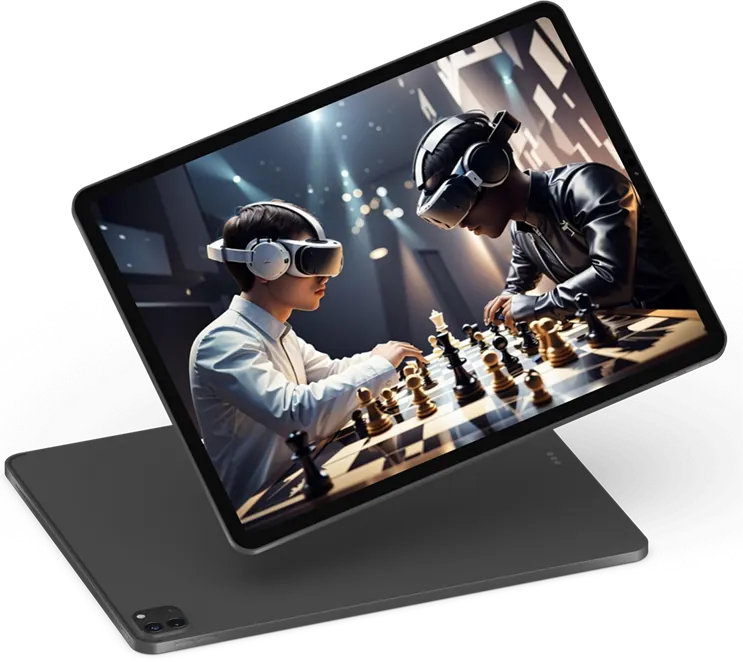
About The Client
The client sought to create an educational yet entertaining chess experience that fully leveraged VR capabilities.
The key features of the VR Chess Game include:
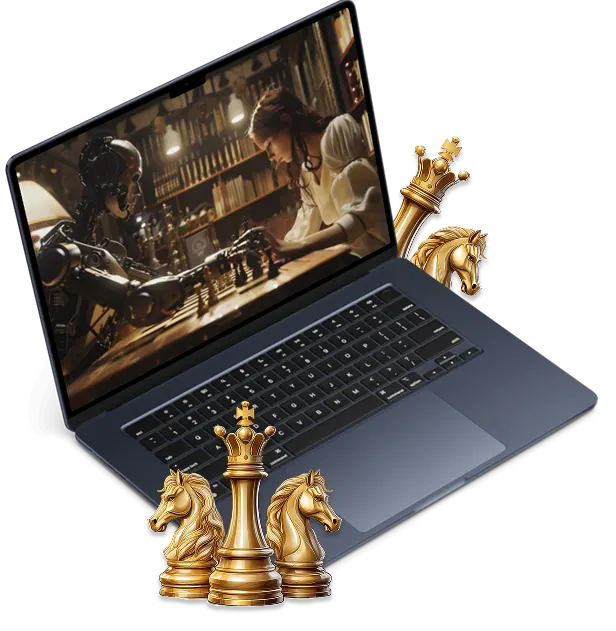
Read more
The client sought to create an educational yet entertaining chess experience that fully leveraged VR capabilities. Their primary goals were to provide an immersive, interactive environment that was intuitive, accessible, and visually engaging. The client emphasized:
The key features of the VR Chess Game include:
- Multiplayer Mode: Players can engage in real-time matches with others, supported by in-game voice chat for seamless communication.
- AI Opponent: Adjustable AI difficulty levels ensure both novice and experienced players can enjoy the game.
- Hand Tracking & Controller Support: Players can use hand gestures or controllers to pick up and move chess pieces, adding a tactile dimension to the experience.
- Gesture-Controlled Zoom and Rotation: The game allows users to zoom in, zoom out, and rotate the board using intuitive gestures.
- Tutorial Mode: A step-by-step guide helps beginners learn the gaming rules and mechanics, with helpful hints during gameplay.
- Match History & Analysis Tools: Users can review their past matches, receive analysis, and learn from their mistakes.
Requirements
We thought to create an educational yet entertaining chess experience that fully leveraged VR capabilities.
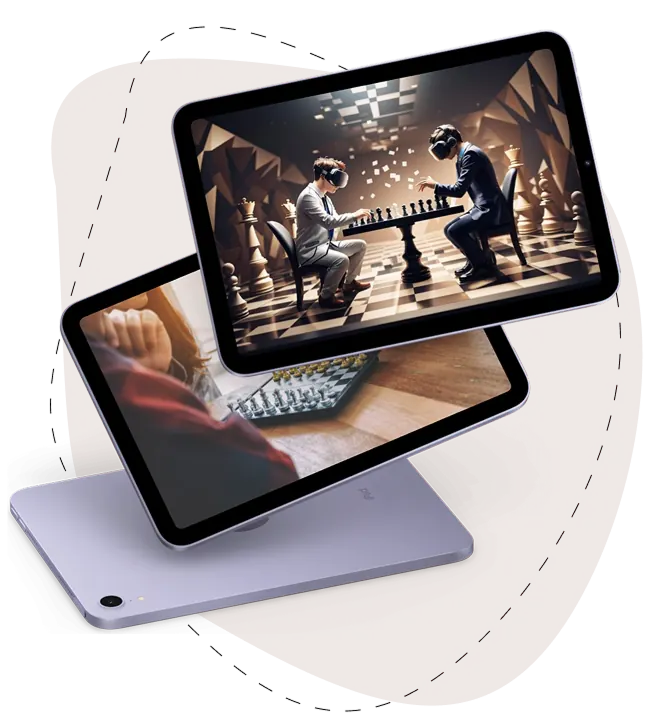
Read more
We thought to create an educational yet entertaining chess experience that fully leveraged VR capabilities. Their primary goals were to provide an immersive, interactive environment that was intuitive, accessible, and visually engaging. The client emphasized:
- Realistic Chessboard Interaction: The chessboard should feel tangible, with natural interactions allowing players to move pieces intuitively.
- Multiplayer & Solo Play: The game should cater to both solo players (against AI) and multiplayer matches.
- Gesture-Based and Controller Interaction: Players should be able to interact with the chess pieces using either hand gestures or VR controllers.
- Visually Thematic Environments: The game should offer distinct, visually immersive environments to play.
- User-Friendly Experience: It will ensure accessibility and comfort, and the game should accommodate various player needs and preferences.
- High-Quality Audio and Visuals: Immersive graphics and spatial audio should enhance the gameplay experience.
- Beginner Assistance: The game should include tutorials, move hints, and other aids for beginners.
- Social Features: Integration of voice chat, emotes, and avatars would provide a social experience.
Challenges
Several challenges emerged during the development of the VR Chess Game:
Intuitive Piece Interaction:
Creating a natural and intuitive way for players to pick up.
Networking Challenges:
Ensuring smooth and synchronized multiplayer experiences in VR required overcoming…
VR Optimization:
Balancing high-quality graphics with performance to prevent motion sickness.
VR Optimization:
Balancing high-quality graphics with performance to prevent motion sickness.
VR Optimization:
Balancing high-quality graphics with performance to prevent motion sickness.
Read more
Intuitive Piece Interaction:
Creating a natural and intuitive way for players to pick up and move chess pieces in VR was challenging. The team had to balance realism with ease of use, ensuring that players could interact with pieces without frustration.
Networking Challenges:
Ensuring smooth and synchronized multiplayer experiences in VR required overcoming latency and connection stability issues.
VR Optimization:
Balancing high-quality graphics with performance to prevent motion sickness and ensure comfort was a significant challenge.
VR Optimization:
Balancing high-quality graphics with performance to prevent motion sickness and ensure comfort was a significant challenge.
VR Optimization:
Balancing high-quality graphics with performance to prevent motion sickness and ensure comfort was a significant challenge.
Development Process
The development of a VR game involves a detailed and systematic approach, integrating creative design, technical proficiency.
Research and Planning
Competitive Market Analysis
The team conducted a competitive analysis of existing VR board games to understand the…
User Research & Feedback Collection
Feedback was gathered from chess players and VR enthusiasts through surveys.
Core Feature Definition
Key features were identified, with an emphasis on multiplayer matchmaking.
Design
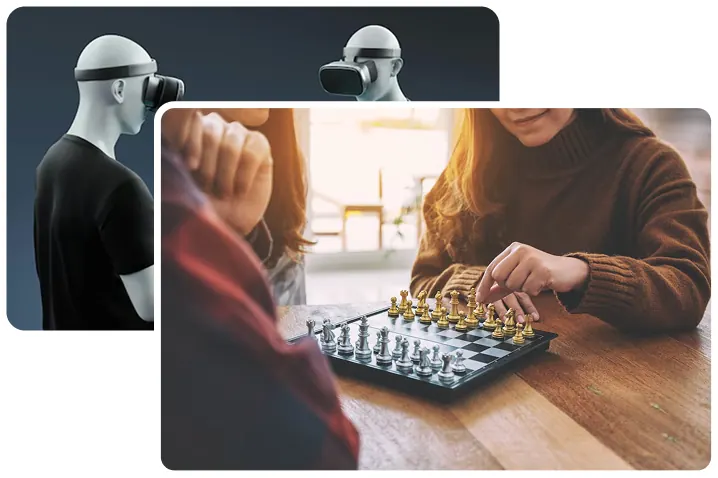
3D Board & Pieces
The design team created stylized chess sets.
UI Elements
VR-specific elements, such as floating menus and gesture-based piece selection.
UX Flow
A streamlined tutorial and contextual prompts were developed to guide players through an…
Development
Testing & Feedback
Read more
The development of a VR game involves a detailed and systematic approach, integrating creative design, technical proficiency, and user-centric experiences to ensure the final product meets both gameplay and immersion standards. Here's a breakdown of the development process for the VR Chess Game:
Competitive Market Analysis
The team conducted a competitive analysis of existing VR board games to understand the market and identify opportunities for innovation.
User Research & Feedback Collection
Feedback was gathered from chess players and VR enthusiasts through surveys and online communities such as Reddit to understand user needs and preferences.
Core Feature Definition
Key features were identified, with an emphasis on multiplayer matchmaking, AI integration, and immersive 3D environments.
3D Board & Pieces
The design team created stylized chess sets with options for different themes (medieval library, forest glade, sci-fi space station).
UI Elements
VR-specific elements, such as floating menus and gesture-based piece selection, were designed to make the experience feel intuitive.
UX Flow
A streamlined tutorial and contextual prompts were developed to guide players through an onboarding process.
Core Logic
The team integrated open-source chess engines to handle the game’s move validation and logic.
Networking
Photon Unity Networking (PUN) was used to power multiplayer functionality, ensuring real-time, low-latency game synchronization.
Interaction
Oculus Touch controllers were combined to support hand gestures and teleportation for navigation.
Sound Design
Spatial audio was incorporated to provide realistic sound cues for piece movements and game events.
Core Logic
The team integrated open-source chess engines to handle the game’s move validation.
Networking
Photon Unity Networking (PUN) was used to power multiplayer functionality.
Interaction
Oculus Touch controllers were combined to support hand gestures.
Sound Design
Spatial audio was incorporated to provide realistic sound cues for piece movements.
Closed Alpha Testing
Conducting an internal test with a select group of users (50 VR testers) to identify bugs and gather feedback on gameplay mechanics, AI behavior, and VR interactions.
User Feedback
Collecting data on user experience, comfort, and immersion. Adjustments are made to reduce motion sickness (e.g., adding vignette effects) and improve user controls.
AI Tuning
Refining the AI to make it more predictable and challenging, ensuring a smooth difficulty curve.
Closed Alpha Testing
Conducting an internal test with a select group of users (50 VR testers) to identify bugs…
User Feedback
Collecting data on user experience, comfort, and immersion.
AI Tuning
Refining the AI to make it more predictable and challenging.
Final Adjustments and Launch
Performance Optimization
Ensuring the game runs smoothly on all target VR platforms by optimizing frame rates and resource usage
Polishing
Fine-tuning the visuals, adding finishing touches to the audio design, and ensuring that all interactions are intuitive.
Launch
The game is prepared for release on platforms like Oculus Store, Steam VR, or others, along with promotional material.
Performance Optimization
Ensuring the game runs smoothly on all target VR platforms by optimizing frame rates.
Polishing
Fine-tuning the visuals, adding finishing touches to the audio design.
Launch
The game is prepared for release on platforms like Oculus Store, Steam VR, or others.
Solutions
Intuitive Interaction Design
Used a combination of raycasting, pinch gestures.
Stable Multiplayer Engine
Built on Photon Unity Networking (PUN) for matchmaking/host state synchronization.
VR-Friendly UI
Created floating, gaze-aware menus that moved with the player's field of view.
AI Integration with Stockfish
Integrated the Stockfish chess engine for AI opponents, enabling levels of difficulty.
Immersive Education Mode
Developed a narrated tutorial with step-by-step VR guidance, ghost-hand animations.
Read more
Intuitive Interaction Design
Used a combination of raycasting, pinch gestures, and controller triggers to allow precise piece movement. Added visual feedback, like snap zones and highlighted valid moves.
Stable Multiplayer Engine
Built on Photon Unity Networking (PUN) for matchmaking/host state synchronization, with built-in voice chat and lightweight avatar support.
VR-Friendly UI
Created floating, gaze-aware menus that moved with the player's field of view. Implemented board scaling gestures to zoom in or out, allowing users to adjust the play scale to their comfort.
AI Integration with Stockfish
Integrated the Stockfish chess engine for AI opponents, enabling levels of difficulty and hint systems based on real-time evaluation.
Immersive Education Mode
Developed a narrated tutorial with step-by-step VR guidance, ghost-hand animations, and visual cues to teach chess fundamentals inside a dynamic environment.
The Benefits
The app succeeded in delivering a modern VR experience with traditional chess at its core.
Engagement
Users spent an average of 25-30 minutes per session.
Global Connectivity
Multiplayer allowed players worldwide to interact naturally as if they were sitting face…
Learning by Immersion
Beginner players reported faster understanding of chess mechanics through the hands-on…
Stress Reduction
The ambient settings created a meditative gameplay experience.
Accessibility
Board scaling, voice commands, and seated mode made the game usable for players.
Technology Used



Hire AR/VR App Developers To Grow Your Business
Do you require an expert team to build scalable, adaptable, and trustworthy architecture for AR/VR apps?
Read more
The app succeeded in delivering a modern VR experience with traditional chess at its core. Key benefits included
Engagement
Users spent an average of 25-30 minutes per session, significantly higher than traditional chess apps.
Global Connectivity
Multiplayer allowed players worldwide to interact naturally as if they were sitting face to face.
Learning by Immersion
Beginner players reported faster understanding of chess mechanics through the hands-on tutorial mode.
Stress Reduction
The ambient settings created a meditative gameplay experience, with many users citing reduced stress during solo play.
Accessibility
Board scaling, voice commands, and seated mode made the game usable for players with different physical abilities.
Hire AR/VR App Developers To Grow Your Business
Do you require an expert team to build scalable, adaptable, and trustworthy architecture for AR/VR apps? Hire our trustworthy AR/VR app developers who provide reliable solutions. Codepth is the ideal partner for your blossoming vision because of its various engagement models and some of the most competitive prices on the market.
Partner with us to hire dedicated AR/VR developers who focus on innovation, scalability, and delivering impactful results, helping you stay ahead in this ever-evolving digital landscape.
Hire VR Game Developers
Why is Codepth IT Solution the leading VR Chess Game Development Company?
Looking for a partner to build immersive and high-quality Chess games?
Custom game mechanics and AI integration
Read more
Looking for a partner to build immersive and high-quality Chess games? Codepth IT Solution stands out as a top VR Chess Game Development Company with a proven track record in creating engaging, innovative, and user-friendly VR experiences. Whether you're looking for a simple chess game or a complex, multi-layered immersive environment, we have the skills, tools, and technology to turn your vision into reality.
User-centered design with intuitive controls
High-quality 3D graphics and immersive sound design
Expertise in Unity3D, Unreal Engine, Oculus SDK, and OpenXR
Cross-platform VR game development (PC, mobile, standalone VR devices)
How we engage
What you get
The same terms on every project, written into the quote.
You own the source code
Full code, repositories and credentials are handed over to you.
A fixed quote
Scope and price are agreed in writing before work starts.
Weekly demos
You see working software every week, not just status reports.
Support after launch
We stay on to fix issues and help you run what we built.
Have a project in mind?
Share a short brief. You get a fixed quote and a clear plan.